

How do you find the right polymer and processing conditions for hot-melt extrusion when you have less than 1 gram of API?
Testing every combination on an extruder is hardly a practical starting point. Even the smallest benchtop extruders require at least 3 g of API per batch, while a spray-dried screening batch can be made from milligrams. With a handful of polymers, drug loadings and temperatures to explore, an extruder-first approach needs tens of grams of API.
Together with Pfizer and Purdue University, we developed a workflow to assess HME feasibility with less than 1 g of API. Published in AAPS Open, the study demonstrated this approach and confirmed that the selected formulation could subsequently be produced by extrusion. The full assessment consumed under 500 mg.
Why consider hot-melt extrusion?
Early ASD development often favors spray drying, while practical guidance for screening HME formulations with little API remains limited. Spray drying requires solvent selection, evaporation, and recovery; HME avoids these steps and can use a smaller equipment footprint, offering potential cost and environmental advantages.
A commercial example is the ritonavir ASD, used with other antiretrovirals to treat HIV-1. Its ASD tablets are manufactured by HME. When our assessment identifies a promising HME candidate, we recommend exploring this route rather than defaulting to spray drying.
But not every drug–polymer combination is suitable for the process. The formulation needs enough heat to remove residual crystallinity without causing excessive degradation.
The key mechanism is the dissolution of crystalline API in the polymer. This can happen below the melting point of the pure drug, and the temperature required depends on the API, the polymer, and the drug load.
Why does the polymer make such a difference? Different drug-polymer interactions change how much API can dissolve at a given temperature, so a formulation that works with one polymer may remain partly crystalline with another.
The ASD phase diagram gives us a thermodynamic boundary: at a given drug load, it indicates the temperature above which the crystalline API can dissolve in the polymer. Whether dissolution is completed during processing also depends on time and mixing. The model therefore identifies conditions worth testing; the experiments establish what works in practice.
The three-step workflow for ASD development
The workflow narrows the polymer candidates in three steps. First, PC-SAFT predicts compatibility and identifies temperatures worth testing. Next, small samples prepared by vacuum compression molding (VCM) at several drug loadings are screened for residual crystallinity, degradation and drug release. Only the remaining candidates move to detailed phase-diagram validation at higher drug loadings, reserving API for formulations that pass the earlier screens.
Step 1: Predict the process conditions before preparing the samples
In this study, we used PC-SAFT modeling in SOLCALC to calculate phase diagrams for encorafenib with four polymers: PVPVA, Soluplus, HPMCAS, and HPMC. The calculations predicted that Soluplus and PVPVA would allow the drug to dissolve at lower temperatures than HPMCAS, while HPMC showed poor compatibility at higher drug loads.
The calculations also help decide what not to test. HPMC would normally have been excluded after the computational screen because of its predicted immiscibility with encorafenib. Here, it was deliberately retained to confirm the expectations as poorly performing polymer.
When compared with the experiments, PC-SAFT captured the overall phase behavior and correctly ranked the polymers without any fitting of drug–polymer interaction parameters or other system-specific adjustments. For Soluplus, however, it predicted a greater reduction in the temperature needed to dissolve the drug than was observed experimentally. The phase diagrams therefore guide the screening, while small-scale experiments check which conditions work in practice.
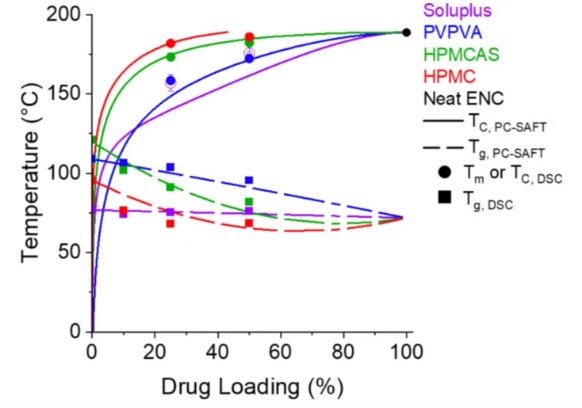
Figure showing how polymer choice and drug loading change the predicted processing boundary.
Step 2: Make a small sample, not an extrusion batch
Vacuum compression molding (VCM), developed by MeltPrep, is an HME surrogate for early screening: it produces a small specimen without running an extrusion batch. A premixed API-polymer powder is heated under vacuum and compression, then cooled into a coin-like disk.
The disks can be examined under a microscope, tested for dissolution, or analyzed for residual crystallinity and degradation, with minimal material loss during molding. VCM specimens can also support stability testing, although physical stability was not evaluated in this study.
What the disks showed: At 25% drug loading, Soluplus samples were translucent at 140 °C, PVPVA samples at 150 °C, and HPMCAS samples at 170 °C. At 180 °C, all three were transparent, whereas HPMC samples still contained opaque regions.
A transparent disk suggests that the drug has become amorphous; a hazy disk can indicate residual crystals or phase separation, so appearance is checked alongside other analytical results. Comparing these observations with the phase diagrams connects those visible changes to the different solubilities of encorafenib in each polymer.
But the polymer that is easiest to process is not necessarily the one that delivers the best formulation. PVPVA disks containing 10% encorafenib released over 90% of the drug within 20 minutes. Soluplus was the clearest illustration of why appearance is not enough: its disks were fully transparent at every drug loading tested, yet released less than 15% of the drug in 60 minutes. The likely cause is gelation of the polymer in the phosphate-buffer medium, which slows release regardless of how well the drug was amorphized. A screen based on clarity alone would have selected the wrong polymer.
HPMCAS presented a different problem: it required higher temperatures to dissolve the drug and showed the lowest thermal stability of the four polymers, with degradation detectable from around 150 °C. PVPVA combined a lower processing-temperature requirement with less degradation and rapid release, making it the preferred candidate for extrusion.
Step 3: Validate the phase diagram at the drug load you actually want
The first two steps narrow the field; the third confirms that the thermodynamic boundary still holds where it matters. Formulation critical temperatures for the surviving candidates were measured by DSC at 25% and 50% drug loading and compared against the PC-SAFT predictions. Agreement was closest for PVPVA, which is the system the model described best.
Because API was limited, these measurements were made at a single slow heating rate. To confirm that this was sufficient, two systems were re-run at five heating rates and extrapolated to zero; the values did not differ appreciably.
From molded disk to extrudate
The team then prepared a formulation containing 20% encorafenib in PVPVA using a laboratory extruder. The extrudate was amorphous by X-ray powder diffraction, showed rapid drug release similar to the lower-loading VCM formulation.
The selected formulation therefore performed well beyond the small test. The phase diagrams and VCM experiments guided formulation selection, while the extrusion settings were established for that equipment rather than copied unchanged from VCM.
Start with the phase diagram, then test what matters
This is the workflow we want to make available earlier in ASD development: identify promising polymers, determine the relevant temperature range at the desired drug load, and test those conditions with small samples. Use the results to select a formulation for extrusion.
The sub-gram API requirement applies to the feasibility assessment, not subsequent extrusion work or complete product development. It allows the first HME decisions to be made when material is still scarce. The assessment is designed to reach a decision in a few weeks.
Which polymer should you choose, and how can you process it?
Talk to Dr. Christian Lübbert about using PC-SAFT modeling to guide HME development for your API.